
WELCOME BONUS 300%
UP TO €2000 + 100
FREE SPINS
Home → Blackjack
Blackjack at Orbit Spins
Insurance vs Even Money When You Hold Blackjack
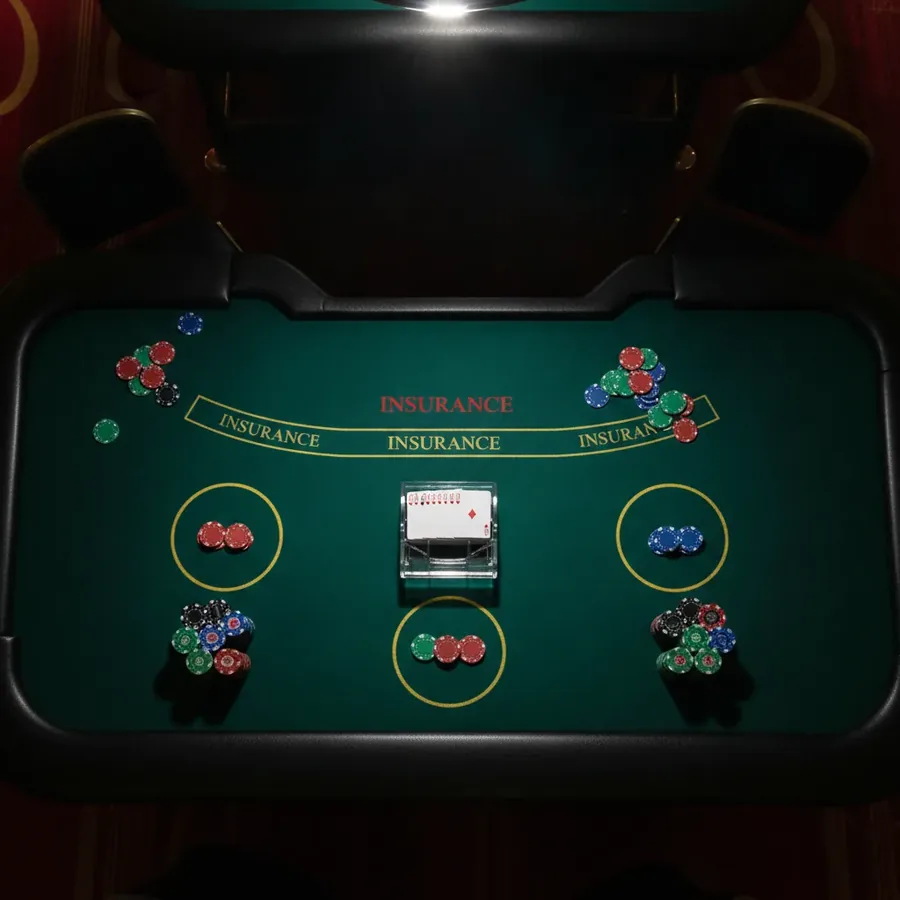
Insurance in Blackjack Insurance (six to eight decks) carries an RTP of 92.53% and a house edge of 7.47%, and it works as a separate side bet of up to 50% of the main bet when the dealer shows an ace. House edge means the average share of each stake the casino keeps over the long run, so 100 € of insurance stakes cost about 7.47 €. That is the figure behind the standard rule that basic strategy always declines the bet.
With a single deck the insurance edge is about 5.88%, which is lower than the 7.47% of the six- to eight-deck version. Insurance itself pays 2:1, so a winning 50 € insurance bet returns 100 €, but the return over many rounds still trails the main game. Card counters accept it only at a true count of plus three or higher, a threshold most players never reach.
Against that, a six-deck game with S17, DAS, DOA and a 3:2 payout returns 99.54% with a house edge of 0.46% under basic strategy, so 100 € of main-game stakes cost about 0.46 € on average. Insurance at 2:1 is the weaker bet of the two, and declining it keeps the main game figure intact. The exception is the counter at a true count of plus three or above.
Infinite Blackjack vs the Classic Seven-Seat Table
Infinite Blackjack from Evolution offers unlimited seats at the table, a bet range of 1 € - 5,000 € and an RTP of 99.47%, with side bets named Any Pair, 21+3, Hot 3 and Bust It. A classic seven-seat table is limited to seven hands per round, so an unlimited table removes the wait for a free seat. The return figure itself does not change with the number of players.
The comparison that matters is the rule set. A six-deck game with S17, DAS, DOA and a 3:2 payout returns 99.54% with a house edge of 0.46%, so 100 € of stakes cost about 0.46 € on average, against roughly 0.53 € on the Infinite Blackjack main game. Six decks instead of eight is worth about 0.02 percentage points, and doubling after a split is worth about 0.14 percentage points.
Resplitting aces improves the return by about 0.08 percentage points, and the dealer hitting soft 17 lowers it by 0.22 percentage points, so the rule card matters more than the seat count. Quantum Blackjack Plus Live from Playtech, with a bet range of 1 € - 5,000 € and Quantum multipliers up to 1,000x on three-card combinations worth 21 points, returns 99.57% with optimal strategy. The exception is a player who accepts a lower figure for unlimited seating.
What the Peek Means When the Dealer Shows an Ace
A peek is the dealer's check for blackjack when the upcard is an ace, and late surrender in Blackjack Surrender is available only after that check has been made. Late surrender lets the player give up the hand and lose half the stake, and it improves the return by about 0.08 percentage points, which on 100 € of stakes is roughly 0.08 €. The returned amount is 50% of the stake.
Early surrender, where the hand is given up before the check, is worth much more, up to 0.6 percentage points, but it is extremely rare. The difference between the two is the peek itself: a hand surrendered after the check cannot escape a dealer blackjack, while one surrendered before it can. That is why the two versions carry different values.
Insurance, the other bet tied to an ace upcard, pays 2:1 but returns only 92.53% on six to eight decks, a house edge of 7.47%, or about 7.47 € per 100 € staked, and basic strategy always declines it. Liberal Vegas Strip, with S17, DAS, resplit and late surrender, returns 99.72% with a house edge of 0.28% and a standard deviation of 1.15. The exception is the counter at a true count of plus three or higher.
Blackjack variants at a glance
| Variant | Payout | House edge | Rule | RTP |
|---|---|---|---|---|
| Blackjack 6:5 payout instead of 3:2 (6 decks) | Blackjack 6:5, win 1:1 | 1.85% | Replacing 3:2 with 6:5 adds exactly +1.39 percentage points to the casino's edge – more than any other rule change. On a €10 bet a blackjack pays €12 instead of €15. | 98.15% |
| Blackjack Split / double / H17 – rule effects | Double – stake ×2 with one card; split – up to 4 hands; split aces usually get one card each. | H17 +0.22 percentage points; RSA −0.08 percentage points; DAS −0.14 percentage points | Dealer hitting soft 17 lowers RTP by 0.22 percentage points; resplitting aces improves it by 0.08 percentage points; doubling after a split improves it by about 0.14 percentage points; 6 decks instead of 8 – about 0.02 percentage points. | n/a (rule modifiers) |
| Blackjack Surrender (late surrender) – rule effect | 50% of the stake returned | −0.08 percentage points | The player gives up the hand after the dealer has checked for blackjack and loses half the stake. Improves RTP by about 0.08 percentage points. Early surrender is worth much more (up to −0.6 percentage points) but is extremely rare. | n/a (rule modifier) |
| Blackjack Liberal Vegas Strip (liberal rules, 3:2) | Blackjack 3:2, win 1:1 | 0.28% | The most player-friendly rule set: S17 + DAS + resplit + late surrender. Standard deviation 1.15 | 99.72% |
| Blackjack 6 decks, S17, DAS, DOA, 3:2 payout, basic strategy | Blackjack 3:2, regular win 1:1, insurance 2:1 | 0.46% | Dealer stands on soft 17; double down on any first two cards; doubling after a split allowed; no surrender. Basic strategy is required to reach this figure | 99.54% |
| Blackjack Insurance (6–8 decks) | Insurance 2:1 | 7.47% | Separate side bet of up to 50% of the main bet when the dealer shows an ace. Basic strategy ALWAYS declines it (except for card counters at a true count ≥ +3). With a single deck the edge is ≈ 5.88% | 92.53% |
Place Side Bets Before the Cards Are Dealt
Insurance is a separate side bet of up to 50% of the main stake and must be placed when the dealer shows an ace, before any further cards are dealt. This side bet pays 2:1, so a €100 insurance stake returns €200 in winnings if the dealer has blackjack. Basic strategy always declines it except for card counters at a true count of +3 or higher.
The long-run return on insurance in a 6 to 8 deck game is 92.53%, which leaves a house edge of 7.47%. That means every €100 placed on insurance loses €7.47 on average over time. With a single deck the edge is approximately 5.88%, still far worse than the main blackjack bet. A player who never takes insurance avoids this drain entirely.
Quantum Blackjack Plus Live from Playtech offers multipliers up to 1,000x on three-card combinations that total 21 points, but the insurance decision remains separate. Evolution's Infinite Blackjack includes four side bets called Any Pair, 21+3, Hot 3 and Bust It, and insurance is not one of them. Each side bet has its own return and should be treated as an independent wager.
Continuous Shuffling Machines Reshuffle After Every Round
A continuous shuffling machine reshuffles the cards after each round, so the discard tray never holds enough cards for a meaningful count. The house edge figures for blackjack assume a basic strategy player, not a counter. For example, a 6-deck game with the dealer standing on soft 17, doubling after splits and double on any first two cards returns 99.54% with basic strategy.
That 99.54% return leaves a house edge of 0.46%, meaning €100 staked loses €0.46 on average. In comparison, the single deck classic rules game with a 3:2 payout returns 99.85%, a lower edge of 0.15% because fewer decks reduce the casino's advantage by about 0.48 percentage points compared with 8 decks. A continuous shuffler removes the advantage a counter might gain from deck penetration.
Lightning Blackjack from Evolution runs with unlimited players and a bet range of 1 - 2,500 EUR, while Infinite Blackjack from the same studio takes bets from 1 - 5,000 EUR. Neither game depends on a shoe for its return figures, which are 99.56% and 99.47% respectively. The shuffler changes the counting opportunity, not the basic strategy return.
Calling Late Surrender Correctly in Three Steps
Late surrender is a rule effect worth 0.08 percentage points to the player, meaning it reduces the house edge by that amount. The player gives up the hand after the dealer has checked for blackjack and loses half the stake. Early surrender is worth much more at up to 0.6 percentage points, but it is extremely rare and not part of the Liberal Vegas Strip rules.
The Liberal Vegas Strip blackjack variant returns 99.72% with a house edge of 0.28%, using the most player-friendly rule set of S17, double after split, resplit and late surrender. Its standard deviation is 1.15. To register late surrender correctly, a player must first wait for the dealer to check for blackjack, then declare surrender, and finally give up 50% of the stake.
The three steps matter because the dealer's blackjack check happens before the surrender decision. If the dealer has blackjack, the main bet loses and surrender is not offered. Late surrender improves the return by about 0.08 percentage points, so on €100 staked it saves roughly €0.08 compared with a game without surrender. The rule is a small but real edge for the player.
A Side Bet Every Round: The Budget Lasts 30 Rounds
Playing a side bet every round changes the budget math quickly. If a player sets aside €1 per round for a side bet, a €30 side bet budget lasts exactly 30 rounds. Insurance as a side bet returns 92.53% in a 6 to 8 deck game, leaving a house edge of 7.47%, so every €100 staked on insurance loses €7.47 on average.
Evolution's Infinite Blackjack offers four side bets: Any Pair, 21+3, Hot 3 and Bust It. Each one is an independent wager with its own return, and none of them improves the main game return of 99.47%. Quantum Blackjack Plus Live from Playtech adds Quantum multipliers up to 1,000x on three-card 21 combinations, but those multipliers land on the main game, not on the side bets.
The welcome offer is a 300% bonus up to €2,000 plus 100 free spins, which can extend a budget when used carefully. A €100 deposit becomes €300 in bonus money, for a total balance of €400 before any wagering applies. A player who spends €1 per round on side bets across 30 rounds would use €30 of that balance while the main blackjack bet continues separately.
Side Bets Raise the House Edge to 5%
Insurance on a six- to eight-deck blackjack game carries a house edge of 7.47%, with an RTP of 92.53%. The house edge is the average share of each stake that the casino keeps over the long run. At 2:1, insurance pays €200 on a €100 side bet, yet basic strategy always declines it because the true odds of a ten-value card are lower than the payout implies.
Across a six-deck shoe, the base game with a 6:5 payout returns 98.15% and holds a 1.85% edge. Adding insurance lifts the combined figure past 5% on the side bet alone. A player staking €100 on insurance in a session risks losing €7.47 on average per €100 wagered, more than four times the base game's 1.85%.
The gap widens further when the main bet is settled at 6:5: a €10 blackjack pays €12 instead of €15, so the shortfall of €3 per blackjack compounds the insurance leak. On a €100 main bet, that is €30 less across ten blackjacks, while the insurance side bet still bleeds €7.47 per €100 staked. Card counters at a true count of +3 or higher are the rare exception.
Ignoring the Basic Strategy Chart: 1 Percent Wasted
A six-deck blackjack game with the dealer standing on soft 17, double down on any first two cards, doubling after a split allowed and no surrender returns 99.54% with a house edge of 0.46% when basic strategy is followed on every hand. Basic strategy is the fixed set of decisions that maximizes the return for each player hand against each dealer upcard. Without it, the same table can give back far more than 0.46%.
The gap between disciplined and undisciplined play is visible in the payout structure. A 3:2 blackjack payout returns €150 on a €100 stake, while a 6:5 payout returns only €120. Replacing 3:2 with 6:5 adds exactly 1.39 percentage points to the casino's edge, more than any other single rule change on the table.
Rule modifiers move the figure in both directions. Dealer hitting soft 17 lowers the return by 0.22 percentage points, resplitting aces improves it by 0.08, and doubling after a split improves it by about 0.14. Six decks instead of eight is worth roughly 0.02 percentage points, so the chart and the rule set together decide what €100 of stakes actually costs.
The Insurance Mistake: 7% Extra House Edge
The insurance wager on a six- to eight-deck blackjack game returns 92.53% with a house edge of 7.47%, against 99.54% and 0.46% for the same six-deck game played with basic strategy. The side bet may cover up to 50% of the main stake when the dealer shows an ace, and it pays 2:1 if the dealer holds a ten-value card underneath. The gap between the two edges is 7.01 percentage points.
On a €100 main bet the maximum insurance stake is €50. Losing that €50 to a 7.47% edge costs €3.74 on average per insured hand, while the same €50 wagered on the main hand at 0.46% costs about €0.23. Basic strategy declines insurance on every hand except for card counters at a true count of at least plus three.
Single-deck insurance is less costly at roughly 5.88%, but single-deck blackjack itself carries a 0.15% edge only when the 3:2 payout is intact. A 6:5 payout turns a €10 blackjack into €12 instead of €15, and that 1.39-percentage-point rule change costs more per hand than insurance does on most hands.
Soft 17: Does the Dealer Hit or Stand?
A dealer who hits soft 17 lowers the return of a six-deck blackjack game by 0.22 percentage points, the largest single rule penalty apart from the 6:5 payout change. The dealer standing on soft 17 is part of the rule set that produces 99.54% RTP and a 0.46% house edge with basic strategy on a six-deck game with doubling after a split and no surrender. On €100 of stakes the difference between the two dealer rules is €0.22.
Doubling after a split improves the return by about 0.14 percentage points, and resplitting aces adds 0.08. Six decks instead of eight is worth roughly 0.02 percentage points in the player's favour. The Liberal Vegas Strip rule set combines standing on soft 17, doubling after a split, resplitting and late surrender for 99.72% RTP and a 0.28% edge.
Late surrender lets the player give up a hand after the dealer has checked for blackjack and lose half the stake, improving the return by about 0.08 percentage points. Early surrender is worth up to 0.6 percentage points but is extremely rare. A €100 stake surrendered under the late rule returns €50.
RNG Deals From a Virtual Eight-Deck Shoe
A random number generator draws cards from a virtual eight-deck shoe, and deck count itself moves the return: six decks instead of eight is worth about 0.02 percentage points, while a single deck is worth about 0.48 percentage points against eight decks. Single-deck blackjack with classic rules and a 3:2 payout reaches 99.85% RTP and a 0.15% house edge. The eight-deck virtual shoe sits at the opposite end of that range.
The 6:5 payout often offsets the single-deck advantage, because replacing 3:2 with 6:5 adds exactly 1.39 percentage points to the casino's edge. On a €10 bet a blackjack pays €12 instead of €15. That single rule change costs more than the deck-count benefit a player gains by moving from eight decks to one.
Live tables such as Quantum Blackjack Plus Live from Playtech run on dealt cards rather than a generator, with a bet range of €1 to €5,000 and Quantum multipliers up to 1,000x on three-card combinations worth 21 points. Its RTP is 99.57% with optimal strategy.
Contact
Live - online chat
Banking









Providers












Orbit Spins 2026